

On 11.02.2026, the President of ASH Berlin, Prof. Dr. Bettina Völter, signed the amendment agreement to the university contracts 2024-2028. During the negotiations, the chapter on sustainability (Section VII) was barely touched upon. ASH Berlin is therefore still required to "complete the transformation process towards a sustainable university" (p. 7).
The following table shows the key sustainability requirements of the amendment agreement. It also lists the processes that the Sustainability and Health department at ASH Berlin has already initiated.
Overview: Previous steps towards sustainability
| Sustainability requirements of the amendment agreement | Previous processes by the Sustainability and Health department |
| Climate neutrality by 2035 and development of corresponding concepts |
|
| Submission of a sustainability concept by 31.12.2026 |
|
| Transformation process towards a sustainable university |
|
| Sustainability in resource management |
|
| Minimization of greenhouse gas emissions |
|
| Participation and qualification of university members at the Sustainable University |
|
| Sustainability and aspects of climate justice in research, teaching and transfer |
|
| Internal university incentive systems for implementation |
|
In addition to the activities listed, other initiatives should also be mentioned. For example, sustainability was established as a criterion for the selection of student projects in the project module of the Social Work degree program. In March 2024, Facility Management took care of expanding the PV system on the roof of the existing building. Since then, the building has generated around 108 MWh of electricity annually. The "Zwischenräume" transfer project has provided important sustainability impetus with the residents' advisory board and the "Productive Region" exhibition (24.06.2025 to 13.09.2025).
Outlook: There is still a lot to do
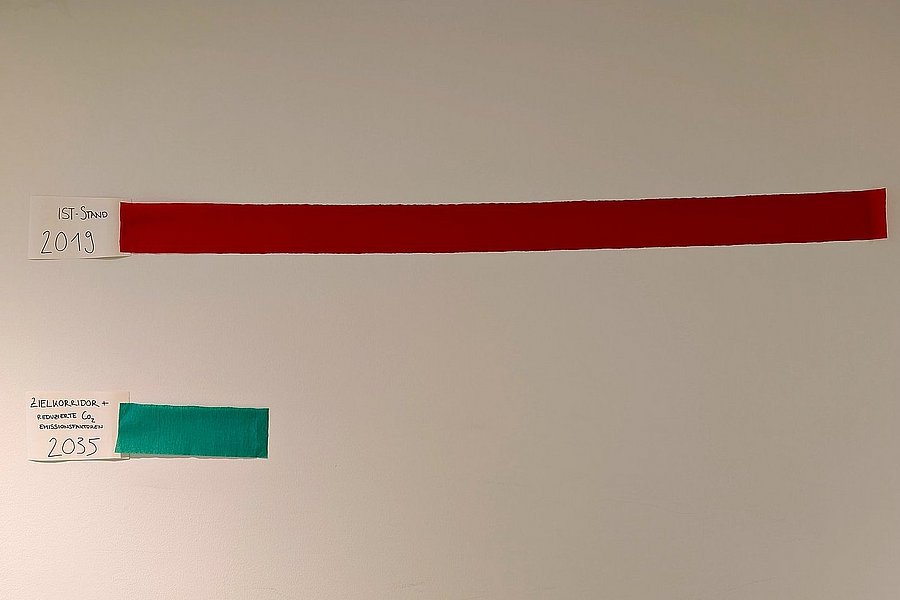
In 2019, which serves as the baseline year for the climate assessment, ASH Berlin'sCO2 emissions were around 2,000 tons. ASH Berlin is a long way from achieving its climate target of almost zero emissions by 2035.
There are signs of slight improvements in the area of mobility. In 2024, theCO2 emissions caused by outgoings fell to 83.4 tons (2019: 157.3 tons) - mainly due to the Green Travel funding of the Erasmus programme. In the same year,CO2 emissions from business trips amounted to 86.9 tons (2019: 137.8 tons). The long-term trends remain to be seen. The opposite is true for energy consumption. Heat consumption (from 812 MWh to 907 MWh) and electricity consumption (from 458 MWh to 701 MWh) have been rising continuously since 2022. Once the new building is fully operational, energy consumption is expected to double - and with itCO2 emissions in this area of operations.
ASH Berlin still has nine years to drastically reduce itsCO2 emissions. To achieve this, structural decisions on direction must be made to a much greater extent than in the past. Comprehensive energy controlling for the existing building and the new building would be important. Energy-related reflection on strategies for digitalization and AI would also be important. There would also need to be an agreement on a reduced quota for air travel - for business trips, study trips and outgoings. A comprehensive incentive system could promote bicycle mobility for commuting. Procurements of 1,000 euros or more should be subject to a sustainability requirement. Finally, the utilization of rooms should be fundamentally improved. At present, the heated and technically well-equipped seminar rooms are poorly utilized due to vacancies (see: "Audit report: Room utilization and attendance in seminars").
The Sustainability and Health department is available at any time for all efforts relating to these and other sustainability and climate issues.
