

KRIKO-BE
Crisis Communication and Governance in Berlin (ASH Project Team)
Project duration: 01/02/2026 - 31/12/2027
Principal investigators: Prof. Dr. Barbara Schäuble, Prof. Dr. Ulrike Eichinger
Project staff: Dr. Eileen Wengemuth, Marja Ellinghaus (research assistants), Meral Karakaş, Tuğçe Karakaya, Lena Schönberg (student assistants)
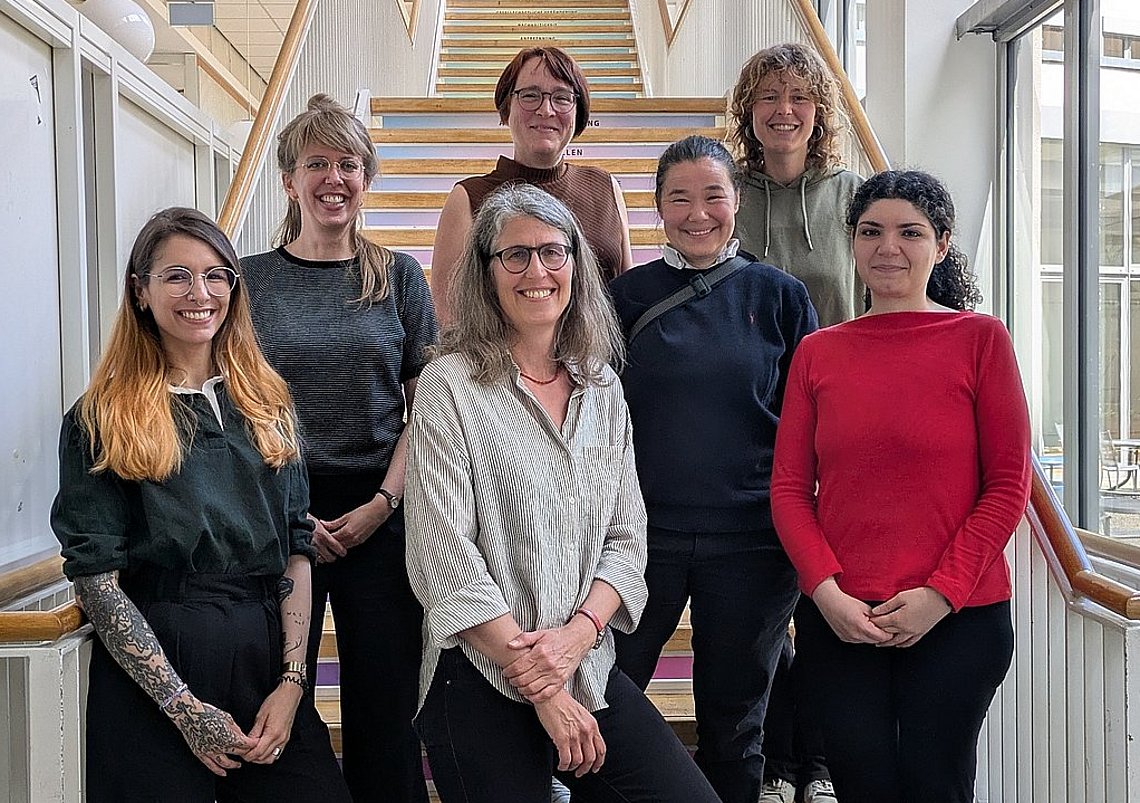
from left to right: Meral Karakaş, Eileen Wengemuth, Ulrike Eichinger, Barbara Schäuble, Marja Solveigh Ellinghaus, Lena Schönberg, Tuğçe Karakaya
Partners:
- IFAF Network of Universities of Applied Sciences: HTW Berlin, BHT, HWR Berlin
- Fraunhofer Institute for Open Communication Systems (FOKUS)
- vr4content GbR
- Berlin Fire Department
- Treptow-Köpenick District Office
- Steglitz-Zehlendorf District Office
- Senate Department for the Interior and Sports
- German Parity Welfare Association, Berlin Regional Association e. V.
Abstract:
Berlin has been affected by various crises in recent years. Against this backdrop, the question arises: How can government agencies, social service providers, civil society initiatives, and citizens work together during crises? The power outage in Steglitz-Zehlendorf provides a recent example that we would like to examine.
KRIKO-BE is an interdisciplinary collaborative project involving four Berlin-based universities of applied sciences. The overall project focuses on communicative, technical, and social innovations for crisis communication and management. We collaborate with social service organizations and district administrations, among others.
The project team from the Alice Salomon University of Applied Sciences in Berlin contributes perspectives on social work and participatory research to the collaborative project.
The focus is on the experiences of:
- social work professionals in government agencies, municipal organizations, and independent agencies
- social work service users, and
- civil society actors
To this end, ASH Berlin is collaborating with, among others, the Steglitz-Zehlendorf district and the Paritätischer Wohlfahrtsverband Berlin.
Among other things, the research project addresses the following questions:
- How do professionals, government officials, and citizens experience crisis situations?
- What forms of collaboration are effective during crises?
- What role do social infrastructure, neighborhoods, and civic engagement play?
- How can municipal crisis management structures be made more equitable and resilient?
- What is the significance of social work for crisis prevention and crisis management?
- How did young people, in particular, experience the power outage?
Methodologically, we use qualitative interviews, group discussions, and collaborative participation formats.
Funding: Institut für angewandte Forschung Berlin (IFAF Berlin)
Keywords: Crisis Experiences, Crisis Research, Disaster Preparedness, Participatory Research, Power Outage
Contact: krikobe@ ash-berlin.eu
Prof. Dr. Barbara Schäuble
Professorin für Diversitätsbewusste Ansätze in Theorie und Praxis Sozialer Arbeit
Room No. 411
Donnerstags 12-13h00
Bitte per E-Mail anmelden und ein Stichwort des Anliegens nennen.
Bei längerfristiger Anmeldung: Prüfen Sie bitte hier noch einmal kurzfristig, ob die Sprechstunde ggf. verschoben wurde.
Keine Sprechstunde am 09.11, 23.11.
Prof. Dr. Ulrike Eichinger
Professorin für Theorie und Praxis der Sozialpädagogik
Room No. 411
Sprechzeiten nach Vereinbarung

