

Project Profile
Sage SAGE! stands for the gender- and diversity-sensitive establishment of system-relevant academicisation in the SAGE fields (Social Work, Health and Care, Childhood and Education).
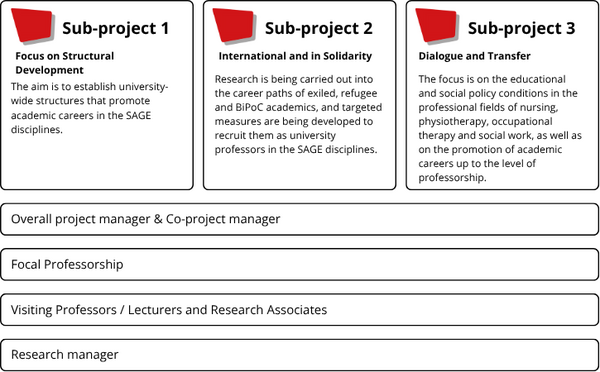
The project is funded from September 2021 to August 2027 within the framework of the federal–state programme FH-Personal and is structured into three sub-projects. Its aim is to develop, recruit and sustainably retain professorial staff for the SAGE disciplines. To this end, the university has established eight focal professorships addressing specific thematic priorities within the sub-projects.
Focusing on System Relevance: Why Strong SAGE Professions Require Excellent Education
The project is grounded in the overarching goal of advancing the academicisation and professionalisation of the SAGE disciplines. In light of increasingly complex demands, diverse and marginalised life realities, and ever more multifaceted professional tasks (e.g. due to migration, demographic change and digitalisation), high-quality academic education forms the foundation for these system-relevant professions.
To prepare professionals for these challenges, the university requires professors who actively foster the transfer between innovative research and practical application. However, this need is contrasted by a significant shortage of professorial staff, partly due to the difficulty of entering academic career pathways. The route to a professorship at universities of applied sciences is often unclear and challenging, particularly due to the requirement of a dual qualification (doctoral degree plus professional practice).
Gender and Diversity as a Core Quality Principle
Professorships within the SAGE disciplines often do not reflect the diversity of society or of the student body. At the same time, multi-perspective approaches in research and teaching are essential for addressing contemporary social issues and societal challenges effectively.
Gender and diversity are therefore embedded as fundamental cross-cutting principles throughout the entire project structure.
Long-Term Objectives of the Project
- Supporting SAGE graduates in pursuing career pathways towards professorship
- Recruiting and relieving professors to enable structural development
- Creating dedicated space for research activities
- Supporting refugee, exiled and BPoC scholars
- Enabling experienced practitioners to transition into academic careers
Framework conditions
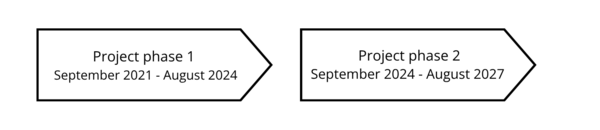
The Sage SAGE! project is divided into two phases, which are also reflected in the staffing of the focal professorships. Some positions are reappointed after three years, while others are limited to one of the two phases.
Focal professorships have been established within the Sage SAGE! project to strengthen professors in implementing structural transformation processes at ASH Berlin.
To allow them to focus on their project work, these positions receive a reduction in teaching load (7 semester hours per week). The resulting teaching gaps are covered by visiting professors, lecturers and research associates funded through the project.
These positions therefore not only relieve existing professors and enable their engagement in the project, but also create opportunities for and support additional academic staff.
Further information on thematic areas and staffing is available on the respective subproject pages.

FH-Personal is a funding programme based on an agreement between the federal government and the Länder. It supports measures aimed at recruiting and developing professorial staff at universities of applied sciences and currently funds 64 institutions nationwide.
The programme addresses the challenge of filling professorial positions amid a shortage of applicants, despite the high demand for qualified staff. Unlike universities, universities of applied sciences do not offer a structured academic career path, although qualification requirements are equally high. Professorial appointments require teaching experience, proven academic ability (usually demonstrated by a doctoral degree), and at least five years of professional practice, including three years outside academia.
Selected Cross-Project Outcomes

The edited volume “academicising, professionalising, transforming. SAGE Higher Education Institutions in Structural Change – The Case of Alice Salomon University of Applied Sciences Berlin” was published in November 2025 by Barbara Budrich and represents a key cross-project outcome.
It addresses questions such as how SAGE institutions can respond effectively to the shortage of skilled professionals despite structural challenges. The contributions present practice-oriented approaches to interdisciplinary, human rights-based and discrimination-sensitive collaboration.
A second, expanded edition will be published in January 2026.
The volume is available both in print and, thanks to third-party funding, as an Open Access publication.
The Sage SAGE! project supports the development of the doctoral environment at ASH Berlin.
The university has applied for the right to award doctorates under the Berlin regulation for universities of applied sciences (HAWPromVO). The application includes the establishment of a doctoral centre titled “New Public Health”, located within a research-intensive area of health sciences.
The aim is to enable independent doctoral degrees at the university and strengthen academic qualification in the interdisciplinary field of health, social determinants and societal conditions.
Until a decision is made, doctoral projects will continue to be carried out cooperatively with partner universities, with ASH Berlin professors already acting as supervisors.
The design of appointment procedures is currently being revised under the leadership of Alexander Unruh (Academic Manager for Appointment Procedures since 1 September 2024).
The aim is to optimise processes, clarify responsibilities, increase transparency and systematically integrate gender and diversity considerations into all stages.
Key developments include:
- A revised appointment regulation adopted in February 2026
- A new guideline for professorial appointments published in January 2026
- A forthcoming appointment handbook (planned for Q2 2026)
- Development of an unconscious bias training programme (planned for 2026)
News: Internal Project Retreat
The next Sage SAGE! project retreat will take place on 10 July 2026.
