

Sub-project 3 – Dialogue and Transfer
Between Higher Education, Professional Practice and Policy
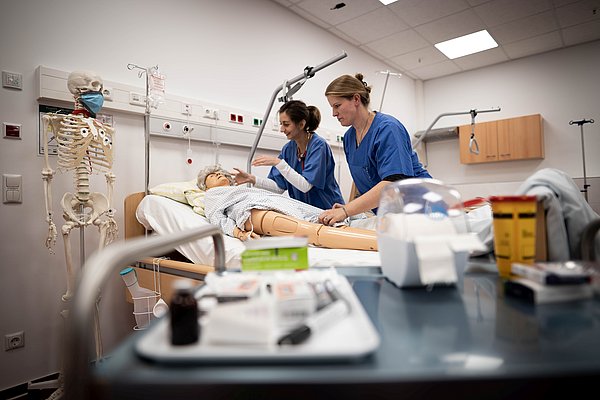
The third sub-project focuses on the educational and socio-political conditions in the professional fields of nursing, physiotherapy and occupational therapy, childhood education, and social work, as well as on supporting academic career pathways up to professorship level.
The academicisation of nursing and the therapy professions is to be further advanced, while the professionalisation potential within social work and childhood education is to be explored through research and dialogue.
Key work packages include:
- Exchange and networking with stakeholders from professional practice, policy and academia
- Initiatives to strengthen sustainable research–practice transfer
- Recruitment of practitioners for academic careers (e.g. visiting lectureships)
- Development and refinement of professional qualification frameworks for newly academicised health professions, as well as for childhood education and social work
- Strengthening the academic foundation of practical study phases in the primary-qualifying Bachelor’s degree in Nursing
Focal professorships
Research and Transfer in Social Work
Prof. Dr. Ulrike Eichinger (2024-2027)
Prof. Dr. Ulrike Eichinger focuses on Critical Social Work, particularly examining the impact of welfare state restructuring on professional standards and working conditions.
Within her focal professorship, she positions research and transfer as strategic responses to current crises in the welfare state and in professional care work. Through conflict-oriented analyses, institutional frameworks and professional scopes of action are reconstructed, and professionalisation potentials in social work are identified collaboratively.
Her subject-oriented, participatory practice research (analysis and transfer) aims at democratic practice development (transformation). The implementation of low-threshold, dialogical formats enables students, alumni and practitioners to (re-)engage with academic work.
A key thematic focus is the strengthening of collective self-organisation as part of professionalisation in social work, alongside the expansion of cooperative research dialogues between academia, practice and political actors (e.g. trade unions).
Research and Transfer in Physiotherapy and Occupational Therapy
Prof. Dr. Elke Kraus (2021-2024, extended to 2027)
Prof. Dr. Elke Kraus conducts research on diagnostics in therapy professions, handedness, laterality and fine motor skills in occupational therapy, participation-oriented practice, interprofessional collaboration, evidence-based practice, and digitalisation.
She has long been engaged in the academicisation and professionalisation of therapy professions, including the further development of degree programmes in physiotherapy and occupational therapy.
Her work within the focal professorship operates at the intersection of professional, health and higher education policy. She advocates for the full academicisation of therapy professions, particularly primary qualification pathways. In response to revised professional legislation, she has developed strategic concepts for the period following the model clause, aiming to ensure long-term quality at an academic level.
Research and Transfer in Childhood Education
Prof. Dr. Claudia Hruška (2024-2027)
Prof. Dr. Claudia Hruška is a social therapist, psychologist and licensed psychotherapist, holding the professorship in Childhood Education with a focus on communication and language development.
Her focal professorship emphasises professional self-care and reflective competence. She understands occupational health as a prerequisite for professionalisation and successful transfer into practice.
Her research explores the conditions of practical study phases as an integral component of Bachelor’s programmes and examines how self-care competencies can be systematically integrated into teaching and transferred into professional practice. At the same time, she contributes to the development of reflective methods to support reflective practice.
Academic Foundation of Practice Supervision in the BA Nursing Programme
Prof. Dr. Katja Boguth (2021-2024, extended to 2027)
Prof. Dr. Katja Boguth focuses on the legal and substantive implementation of reforms related to the Nursing Professions Act.
Key elements include the transformation of nursing education into a dual study format and the integration of advanced qualification goals, such as enabling graduates to carry out certain clinical tasks (e.g. in diabetes care, dementia and chronic wound management).
Her focal professorship incorporates findings from the successfully completed research project LoKoHoPa (Learning Location Cooperation in Academic Nursing Education), which focuses on improving collaboration between universities and practice partners through digital learning management systems.
The framework curriculum developed during her previous term is now being transferred into a digital learning environment to better evaluate and support students’ individual competence development in practice.
Visiting Professors / Lecturers and Research Associates
Barbara Pulfer
Barbara Pulfer has been a state-certified occupational therapist since 2001 and has worked in various psychiatric settings, including addiction care, forensic psychiatry and general psychiatry. She teaches in the interdisciplinary degree programmes in physiotherapy and occupational therapy.
Her teaching focuses on psychosocial aspects and foundational theories of occupational science, supporting the positioning of occupational therapy as an independent academic profession. A key emphasis lies on the therapeutic relationship, balancing care for others and self-care, and fostering responsibility through critical thinking.
Her overarching teaching goal is to promote a confident and informed understanding of the added value of occupational and physiotherapeutic perspectives for clients and patients within interdisciplinary collaboration.
She also emphasises the political responsibility of therapists and aims to pass on awareness of professional agency to future generations. As part of the first Sage SAGE! conference in 2022, she contributed to a panel discussion using a fictional case study to illustrate the benefits of academicisation. The results were later published in the edited volume “academicising, professionalising, transforming.”
Raven Indigo Maag
Raven Indigo Maag’s research focuses on reconstructing biographical experiences in contexts of violence, particularly sexualised violence, from a consistently emic perspective.
Their work centres on how individuals interpret and integrate their experiences into their life narratives, understanding experiential knowledge as an independent source of insight. Social work serves as a key reference point, both as an academic discipline and a field of practice in which interpretations of lived realities are produced.
Their research examines how social pedagogical knowledge systems and institutional frameworks shape or limit the articulation of experiences and how affected perspectives are marginalised.
The work is situated at the intersection of biographical research, feminist and critical approaches, and theories of epistemic inequality. Methodologically, it employs reconstructive approaches to uncover both explicit and implicit structures of meaning.
Overall, the research aims to contribute to a recipient-oriented, power-critical and epistemically sensitive development of social work, strengthening experiential knowledge and reflecting on its conditions of recognition. Raven Indigo is also part of the “Betroffenheit.Macht.Wissen” network, in which researchers who have experienced sexualised violence in their own lives address the marginalisation of experiential knowledge within academia and bring victim-led knowledge generation into the discourse.
Irina Höfker
Irina Höfker’s expertise lies in childhood education, with a particular focus on professional communication, language and multilingualism in educational contexts.
In her teaching, she combines theoretical foundations with practice-oriented approaches, with a strong emphasis on developing reflective and action-oriented competencies. Her work also focuses on counselling, conflict mediation and violence prevention, promoting communication skills and constructive conflict management.
Within the project, she supports Prof. Dr. Claudia Hruška in developing the Communication and Language Learning Lab (KoSe) and contributes to its conceptual advancement.
In addition to her academic work, she is actively engaged in open-child and youth work at a supervised playground. The close integration of practice and teaching shapes her profile and ensures continuous alignment of academic content with current professional practice.
Daniela Hoja
Daniela Hojas' text will follow shortly.
Selected Sub-project Outcomes
Within the subproject, the bimonthly dialogue format “Social Work Workshop” was established for graduates and practitioners of social work with an interest in academia. The event enables participants to reflect academically on their professional practice, develop doctoral projects, and prepare for entry into academic contexts, such as the module specialisation Reconstructive Social Work.
Current topics and methods are documented by participants in a blog.
Together with the focal professorship “Transfer and Third Mission” from Subproject 1, a quarterly colloquium on conflict-oriented social work was initiated. Students and alumni from the BA and MA Social Work programmes participate and use the space to exchange ideas on conflict-oriented theses, publications and doctoral projects.
With a view to permanently embedding primary-qualifying study formats in physiotherapy and occupational therapy within Berlin’s higher education landscape, a post-model clause concept and a key issues paper were developed with input from various experts.
Over the course of the project, the working basis of the focal professorship in physiotherapy and occupational therapy changed significantly. Considering the planned revisions to the professional laws in both disciplines (PT 2025 and OT 2027), the Senate Department decided to initially suspend the degree programme until then.
The current focus is therefore on improving study conditions and targeted public relations work for the additive degree programme in Physiotherapy and Occupational Therapy (AddIS).
The aim of this concept is to better organise and increase transparency around the growing complexity of structures, processes and networking needs in teaching, research, early-career support and practice transfer.
At its centre is the platform “digital GEWINNT”, which connects three key areas:
- Academia, research and teaching
- Early-career support for master students and doctoral candidates
- Transfer between higher education and practice, such as alumni and practice partners
This networking is intended to improve exchange, cooperation, knowledge management and quality assurance, while also enabling new research and development impulses.
The platform offers functions such as forums, search structures, joint events and digital communication spaces. Technically, implementation could take place via an adapted Moodle system (OnCampus), with integrated tools such as BigBlueButton. Staffing resources would be required for operation and moderation.
Overall, the concept aims to make the university more efficient, transparent and future-oriented through digital networking, particularly in the context of digital transformation and growing institutional demands. In future, the concept could serve as the basis for a third-party funding application.
This draft describes the development of a mobile, interactive exhibition for the Physiotherapy and Occupational Therapy degree programme (PTET) at ASH Berlin.
The aim is to make the significance and necessity of academicising the therapy professions visible, understandable and tangible, particularly against the backdrop of limited political visibility and unclear prospects.
The exhibition functions not only as an information format, but also as a strategic instrument for degree programme development, public relations, student recruitment and political positioning. It addresses various target groups, including students, practitioners, decision-makers and the wider public.
The exhibition follows a clear dramaturgy:
- Past – development and establishment of the degree programme
- Present/future – challenges and requirements facing the therapy professions
- Response – presentation of the PTET degree programme as a solution and model
The exhibition is designed as a mobile, modular and hybrid format, combining physical and digital elements. Interactive components such as quizzes, feedback stations and media content are intended to stimulate dialogue between the university, professional practice and society.
As part of the focal professorship in physiotherapy and occupational therapy, an innovative toolkit for evidence-based practice in the therapy professions was developed. It was tested and further developed in direct connection with the degree programme.
Most recently, it was expanded to include an EBP map, enabling individuals and institutions to document their EBP status. In addition, an interdisciplinary development and research group was established: Physiotherapy and Occupational Therapy Development and Research Group for an Evidence-Based Practice Toolkit.
In pursuit of the academicisation of professional nursing, a German-language CanMEDS Nursing model was developed. As part of curriculum development to strengthen theoretical foundations in the primary-qualifying Nursing degree programme, the model serves as a basis for discussion.
It addresses the different roles and associated core responsibilities in nursing and thus provides a foundation for competence-oriented teaching.
In a further step, the framework curriculum was fully adapted to the Nursing Studies Strengthening Act (Pflegestudiumstärkungsgesetz) and the associated transfer of clinical responsibilities for people of all ages with diabetic metabolic conditions, chronic wounds and dementia. The module handbook and programme-specific regulations were subsequently fully revised.
As part of her focal professorship, which strongly emphasises students’ reflective and self-care competencies, Prof. Dr Claudia Hruška founded the Berlin Contemplative Education Network (BeCEN).
The network is dedicated to integrating contemplative practices, such as mindfulness, reflection exercises and meditative approaches, into academic teaching and professional practice. The aim is not only to impart specialist knowledge, but also to strengthen personal development as part of holistic professionalisation.
Monthly meetings of various stakeholders from mindfulness-oriented educational contexts also provide opportunities for direct networking and transfer between higher education and practice.
To strengthen interprofessional collaboration among the SAGE professions, Subproject 3 adopted a multi-step approach.
In addition to developing the concept for the digital exchange platform “digital GEWINNT”, the working group Cross-Programme Teaching Offers (StüLA) was also established. Furthermore, cooperation with both departments was promoted in order to develop an interprofessional basic structure at ASH Berlin.
Together with sub-project 1, “Health and Sustainability Management”, factors affecting professorial health are identified, and the development of measures at both organisational and supra-organisational levels is initiated and supported, for example to ensure a fair distribution of the supervision of final theses and to promote the revision of the Berlin Staff Representation Act.To this end, synergies are created through cooperation with the Higher Education Teaching Care Initiative organised within Ver.di. The aim is to support the working capacity of structurally overburdened professorial staff at universities of applied sciences in the SAGE disciplines and thereby strengthen long-term retention perspectives.
Former project members 2021-2025
Focal Professorships:
- Prof. Dr. Anja Dieterich (2022-2024): Academic Foundation of Practice Supervision in the BA Nursing Programme
- Prof. Dr. Gudrun Piechotta Henze (2021-2022): Academic Foundation of Practice Supervision in the BA Nursing Programme
- Prof. Dr. Julia Franz (2021-2024): Research and Transfer in Social Work
Visiting Professors / Lecturers and Research Associates:
- Katrin Hermsen (visiting professor)
- Bennet Priesemuth (visiting professor)
